A PeaceDrone Product
The tuner for every instrument in your collection.
Join the PeaceDrone mailing list for rare updates on new releases. No spam, ever.
You are in tune. We'll be in touch.
Three Distinct Meter Modes
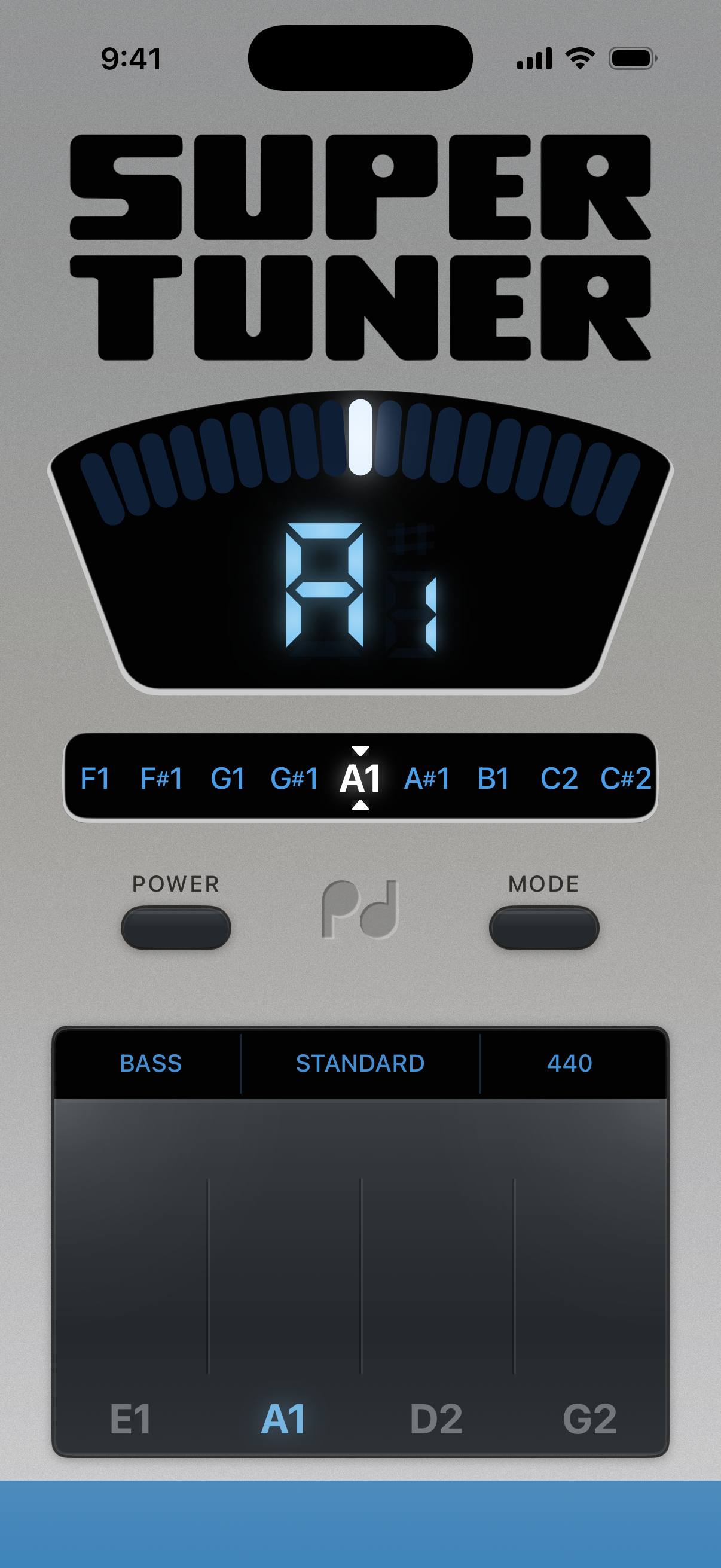
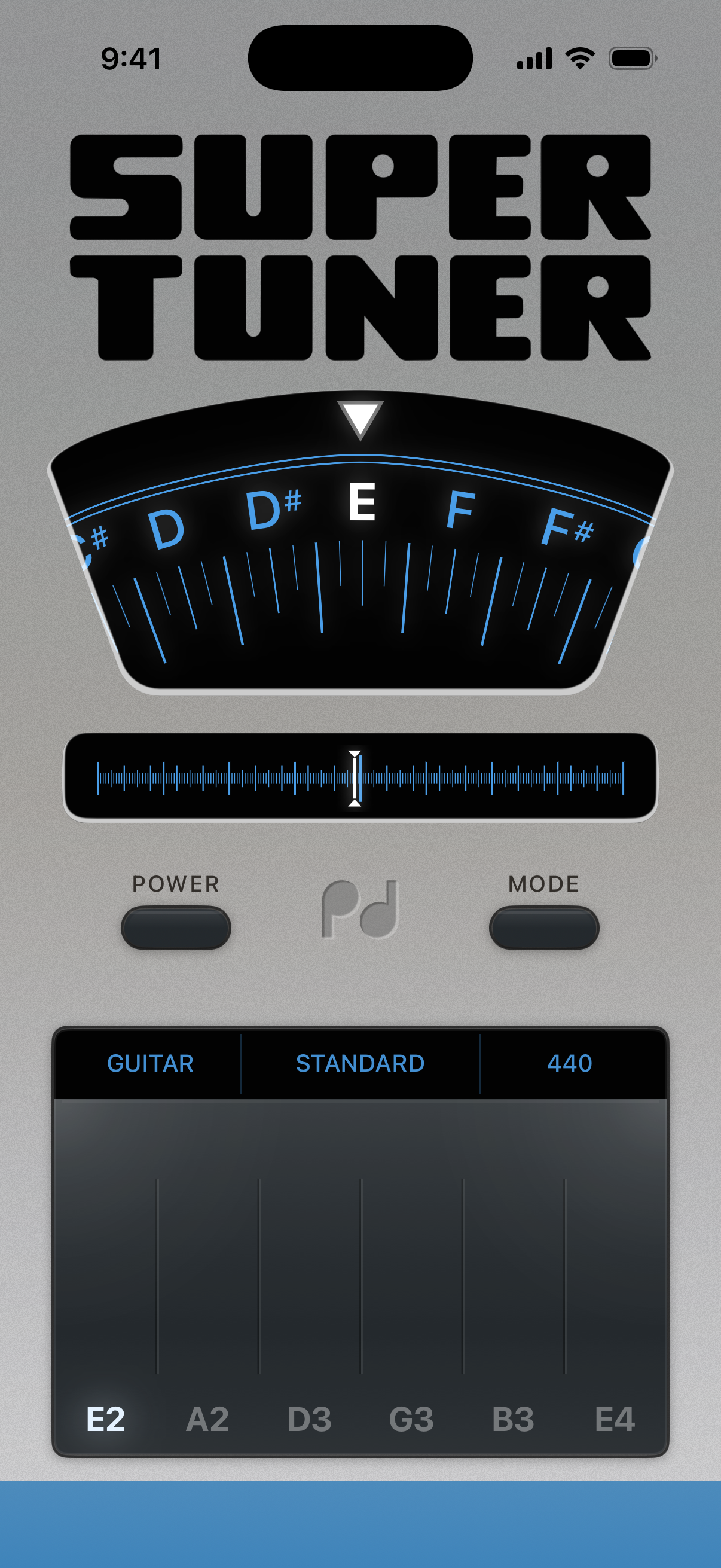
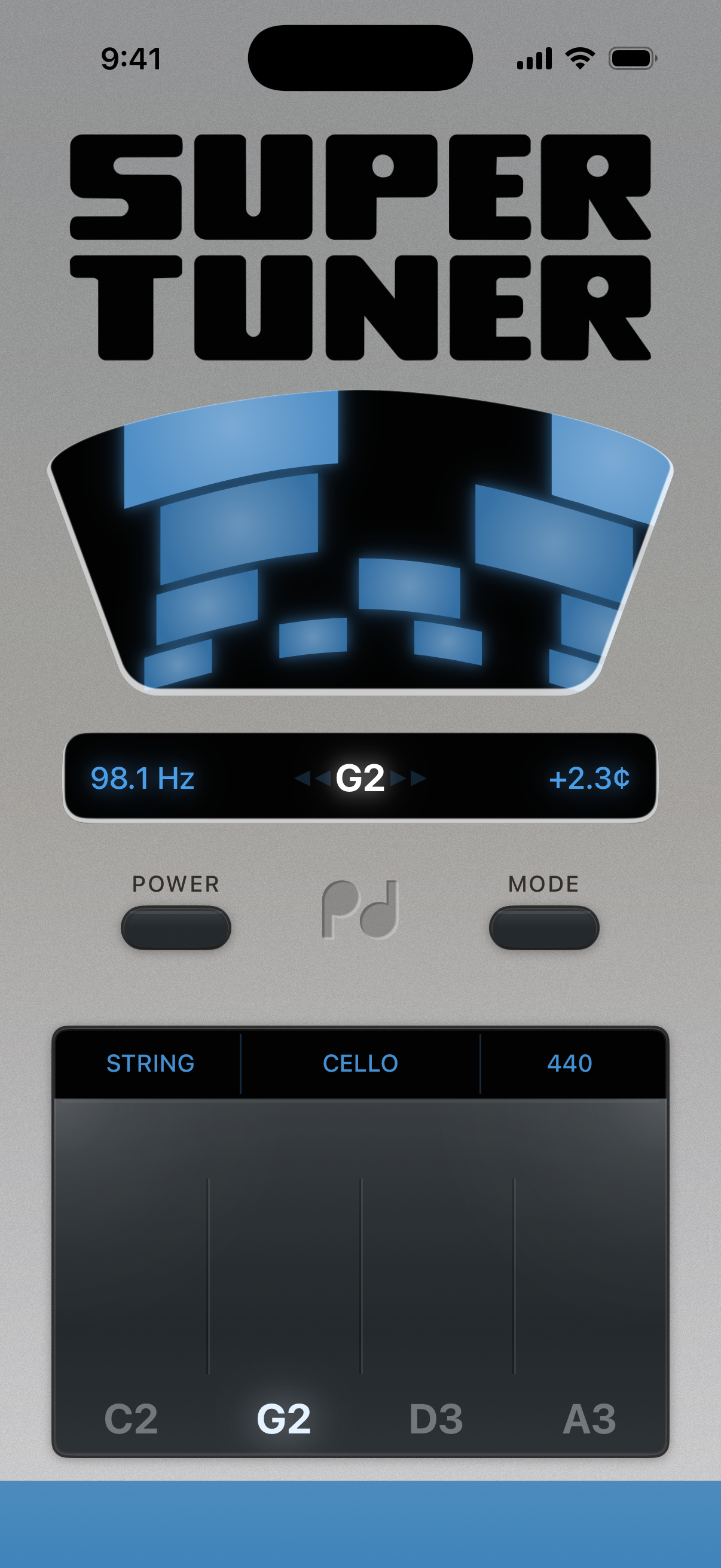
Each main meter is paired with a sub-meter underneath. Tap to cycle independently, or hit the Mode button to flip both at once through three matched setups.
Snappy,
like a pedal tuner
LEDs arc across the display, centering when you're in tune. Below them, a chromatic strip shows your note relative to the target. It's simple, reliable, and easy to use.
The note in the context of the musical spectrum
The chromatic wheel shows where you are, and a fine-tune cents ruler sits underneath. It's the logical flip of the previous mode, with the big picture up top and the fine tune below.
Real phase velocity, like a hardware strobe
Four rows of bars represent the fundamental and three harmonics. When they drift left you're flat, when they drift right you're sharp, and when you freeze them in place you're perfectly in tune. You'll increasingly notice the difference between close enough and in tune.
Cycle the pairings,
or mix them
Tap either face directly to cycle just that one. The Mode button advances both together. Any main meter pairs with any sub-meter.
Tune by ear,
like in the long ago
Before modern tuners, everybody tuned by ear. In the classical days, tuning forks were carefully transported between countries to establish common reference standards. A few hundred years on, folk musicians tuned to a pitch pipe. It works, and it builds the ear, deepening the connection between musician and instrument.
So we included a tone generator for every preset. Since tapping buttons on and off is no fun, we put it on an adaptive ribbon controller. Swipe your finger to audition a new tuning, or tap a note name to hold a reference. Latch up to three notes at once to hear interval relationships. It's a great way to explore the presets.
Designed to help you explore new tunings
SuperTuner ships with 140+ presets across 19 instrument families. Guitar alone covers 17 tunings, or 28 if you count the extended baritone, 7-, 8-, and 12-string variants. Beyond guitar, the catalog spans Western strings, brass, woodwinds, Indian classical, East Asian, and West African traditions. Whether you're tuning a sitar, an oud, or a kora, the preset is in there.
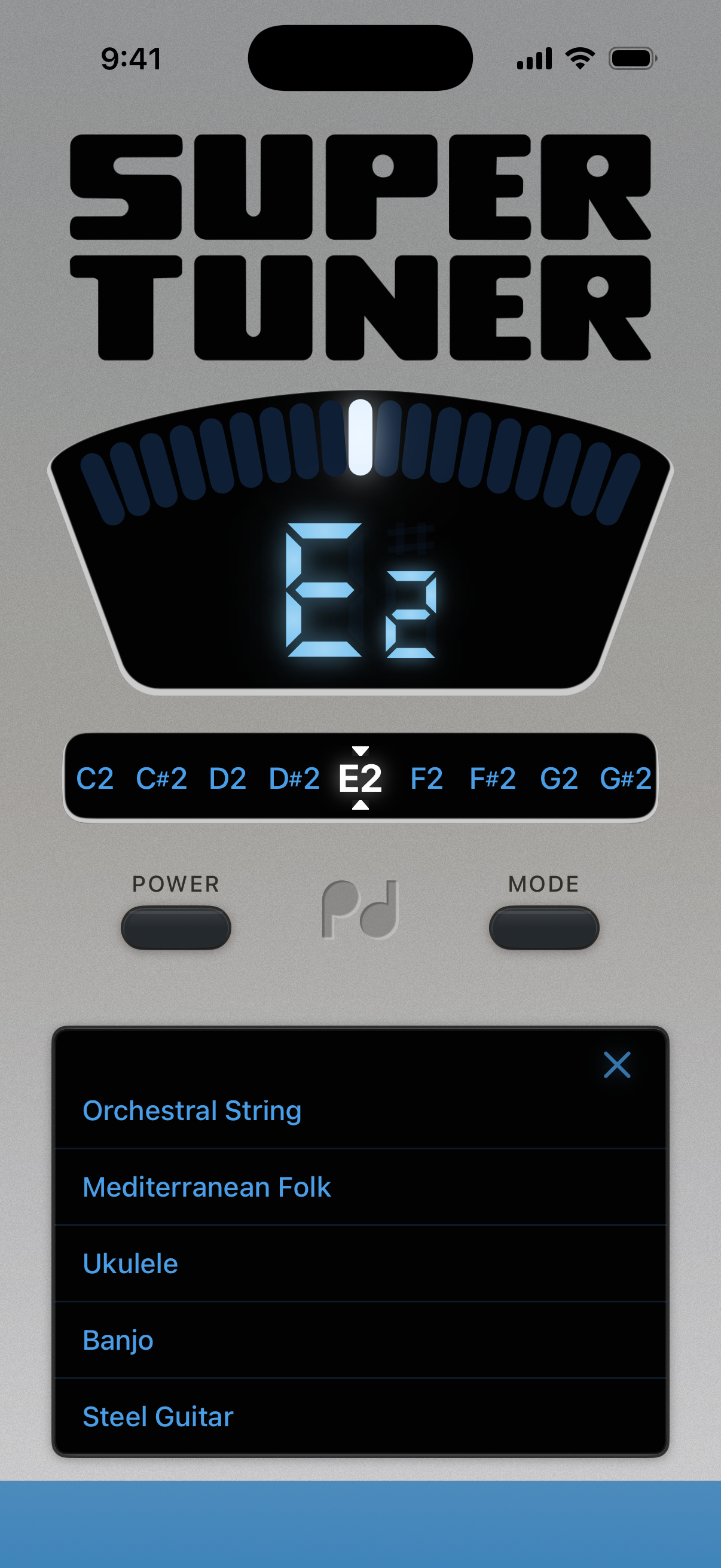
Group Menu
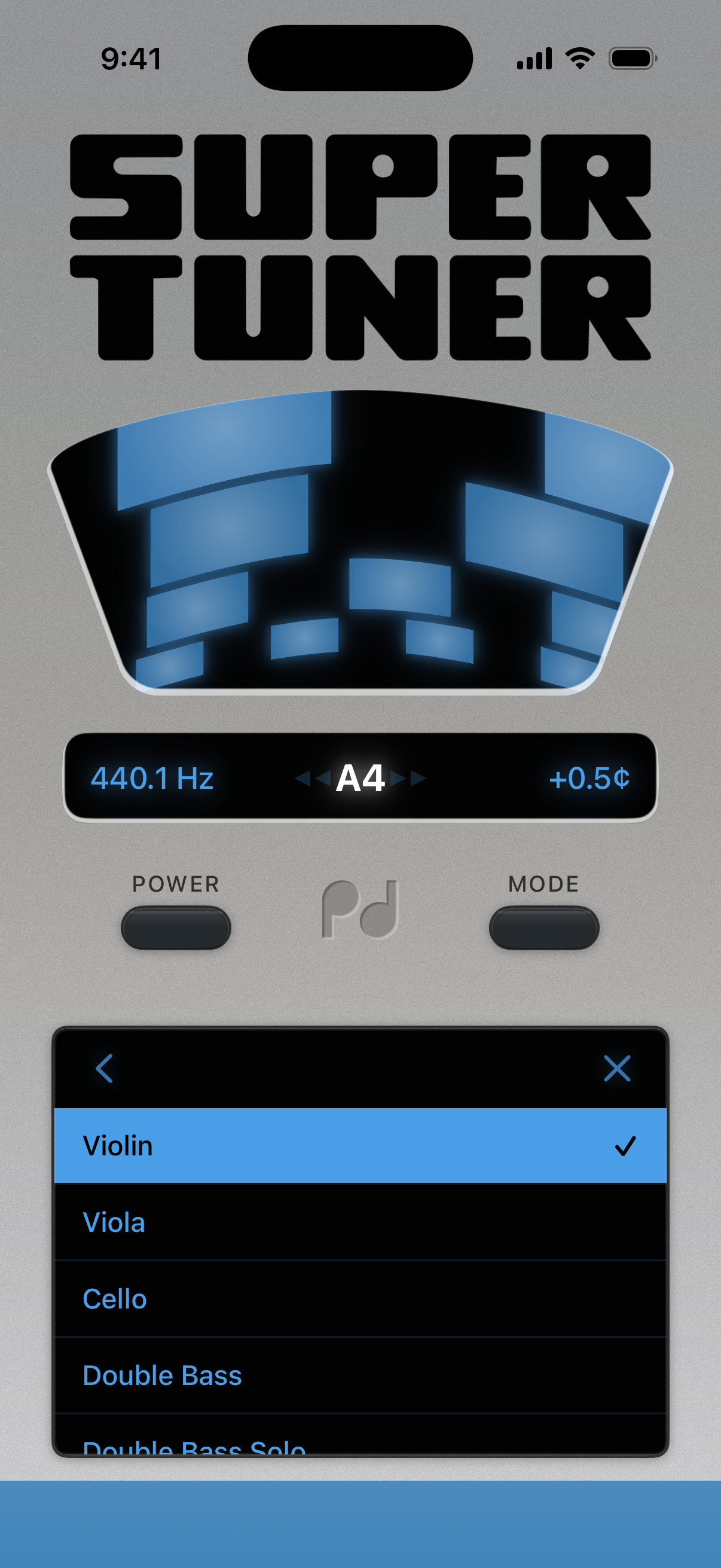
Orchestral String
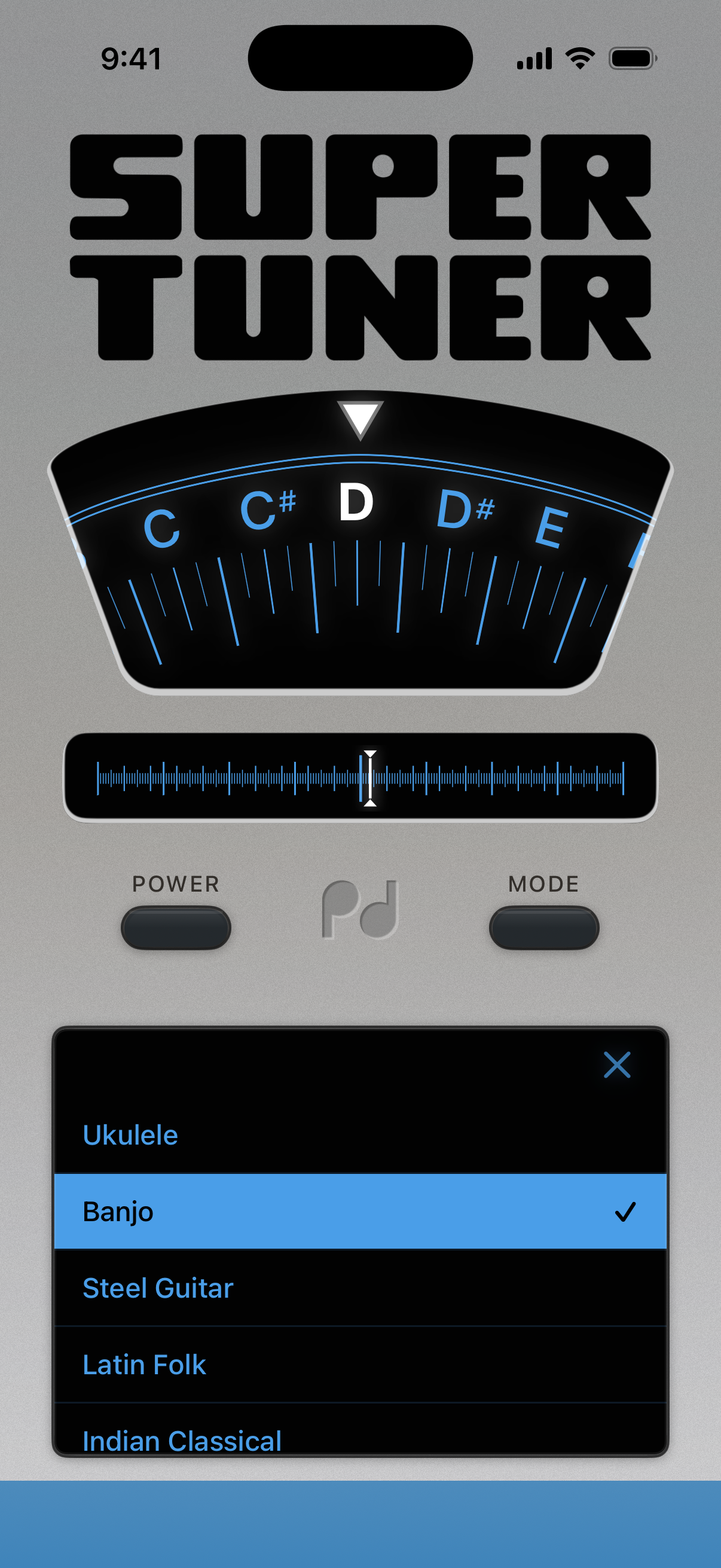
Banjo Family
Indian classical tuning,
anchored at Sa
Selecting any sitar, tanpura, sarod, or thaat preset automatically enters Indian Classical mode. The tuner targets the exact just-intonation ratios above your chosen Sa, not the 12-TET semitones a Western tuner would snap to. Every readout switches with the mode: the segmented LED renders sargam glyphs (Sa, re, Re, ga, Ga, Ma, ma, Pa, dha, Dha, ni, Ni), the chromatic strip and info bar carry the same names with traditional dot-above and dot-below octave markers, and a Carnatic toggle swaps to South Indian swara names. Set Sa once and the rest follows.
Reference pitch for
the 432 heads and
chamber musicians
SuperTuner ships with nine historical and modern presets, plus a free-form slider that runs from 400 to 480 Hz at 0.1 Hz precision. The reference affects everything: pitch detection, note naming, cents calculation, and the tone generator. Change it and the whole app retunes instantly.
- A = 415 Hz Baroque
- A = 416 Hz Half-step down
- A = 430.54 Hz Scientific (C=256)
- A = 432 Hz Verdi
- A = 440 Hz ISO Standard
- A = 441 Hz Boston Symphony
- A = 442 Hz New York Phil.
- A = 443 Hz European Concert
- A = 444 Hz European Bright
- Free 400–480 Hz
Eight historical temperaments,
anchored to any tonic
SuperTuner ships with eight Western temperaments: Equal, Pythagorean, 1/4-comma Meantone, 1/6-comma Meantone, Werckmeister III, Kirnberger III, Vallotti, and Young. Pick one, anchor it to any chromatic tonic, and the tuner retargets every preset note to the period-correct frequency. A small badge in the display bar tells you which temperament is engaged, and the feature toggles cleanly on and off so you can compare against equal temperament without losing your selection.
One layout,
every iOS device
A single codebase is hand-tuned for every form factor, from iPhone SE through Pro Max and iPad mini through iPad Pro, plus Split View. The app draws itself to fit.
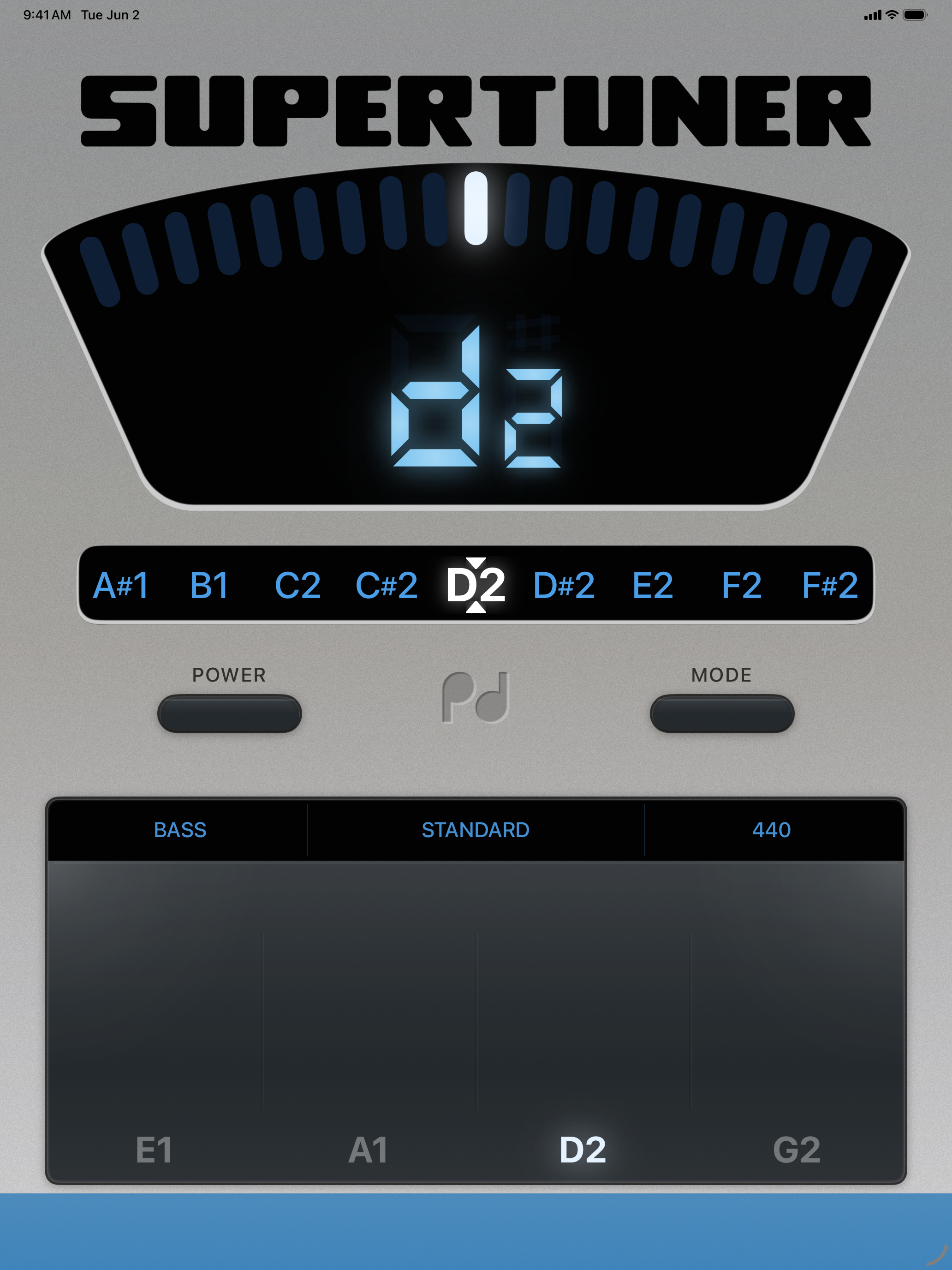
iPad · LED Arc
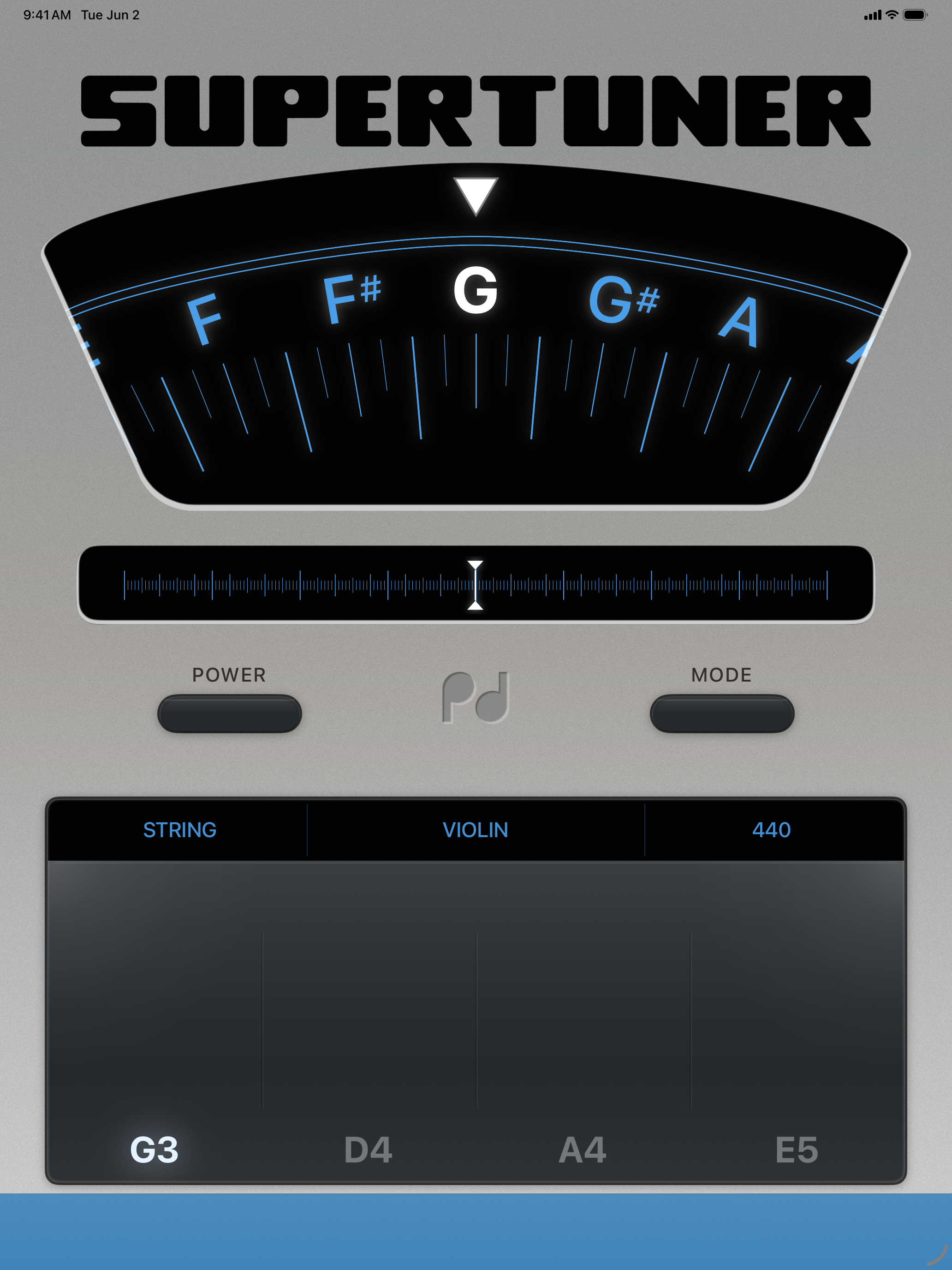
iPad · Chromatic Wheel
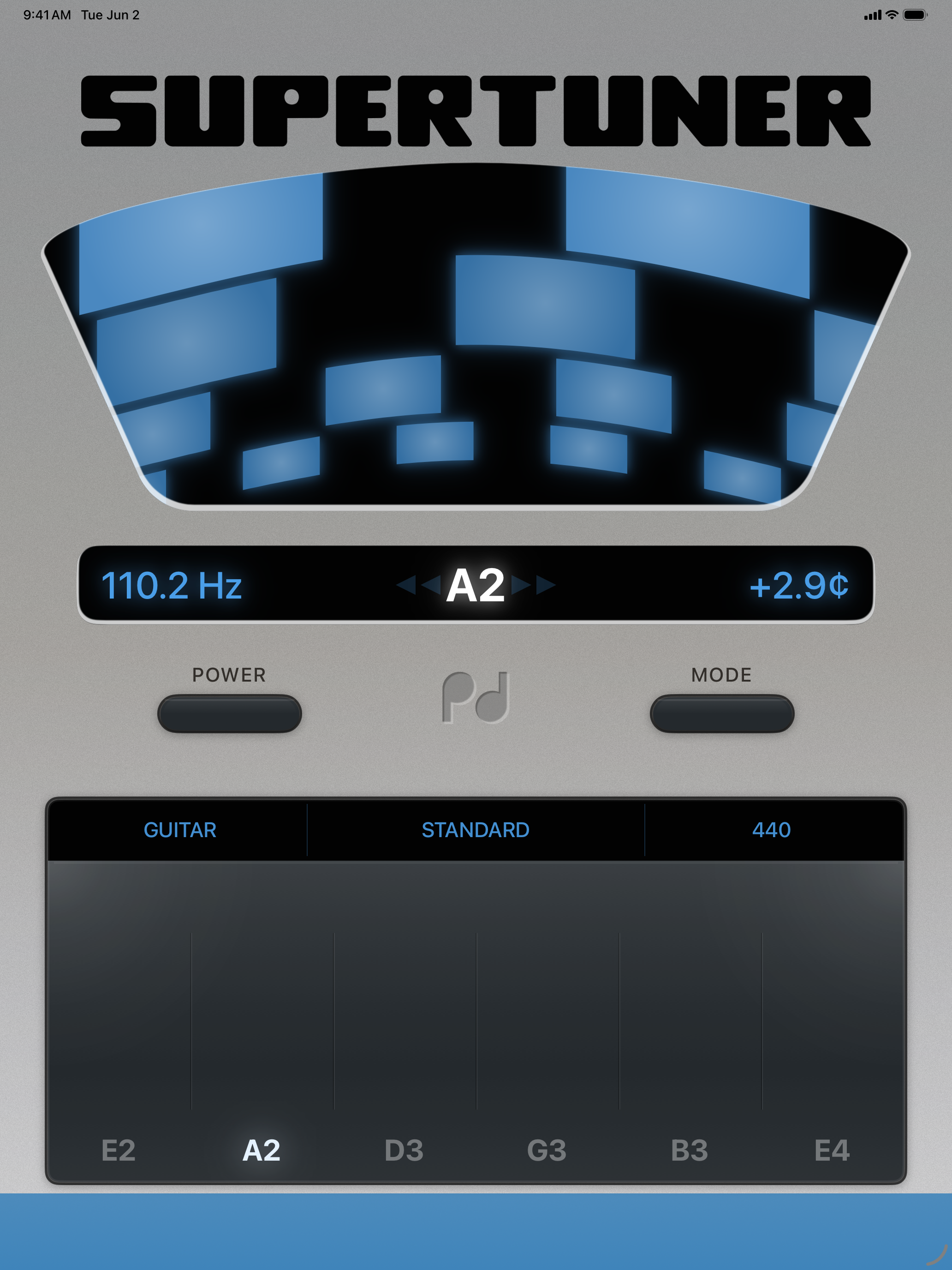
iPad · Stroboscopic
At the core, a custom
note-detection algorithm
Most tuners run on one algorithm. The most common is YIN, which is fantastic for note detection but falls apart on the low end, leading to false or inaccurate readings. That's why your bass never tunes right through your guitarist's pedal.
On the other side there's autocorrelation, which can be slower but shines on the low end. We use both. YIN runs continuously and handles the vast majority of notes you'll play. When YIN detects a low note, it also has to pass an autocorrelation check. The check runs concurrently, so nothing slows down. The result is a tuner that is extremely accurate and sensitive across the full musical spectrum, while reliably rejecting room noise.
| Frequency Range | ~30 Hz (B0) to ~1.5 kHz |
| Sample Rate | Hardware-native (typically 48 kHz) |
| Analysis Window | 2,048 samples (~43 ms) |
| Hop Size | 512 samples (75% overlap) |
| UI Refresh | 20 Hz from audio thread |
| End-to-end Latency | 32 to 96 ms input to display |
| CPU (steady) | 3 to 8% on modern iPhone, under 12% on iPhone SE 1st gen |
| Memory | Under 40 MB resident |
| Energy Impact | Low (Xcode metric) |
For a deep dive on the math, tech specs, and design decisions, check out the Technical Documentation.
We don't hear you tuning
We don't want to.
SuperTuner is entirely private and free of ads. Audio is analyzed on your device and never leaves. We build with attention and care. We wouldn't dream of cluttering our surfaces with ads. We have no interest in data harvesting or surveillance capitalism. We build useful, beautiful tools. We hope you enjoy them.
SuperTuner is a PeaceDrone product.
| Platform | iOS, iPhone & iPad (Universal) |
| Minimum iOS | iOS 16.6 |
| Permissions | Microphone only |
| Network | None, fully offline |
| Analytics | None |
| Data Collection | None |
| Third-Party SDKs | None |
| Audio Processing | On-device only |
| Publisher | PeaceDrone LLC |
Launching soon on the App Store
Be the first to know when SuperTuner ships.
One email when it lands, plus rare updates from PeaceDrone.
Occasional updates on new releases and experiments. No third parties, no tracking, no spam, ever. The same privacy promise as the app.
You are in tune. We'll be in touch.